
Equine Gastric Ulcers: What New Research Means for Your Horse

Equine gastric ulcers are among the most common health conditions affecting horses, particularly those in training, competition, or intensive management. While treatment with medications such as omeprazole remains important, new research suggests there is much more to ulcer prevention and recovery than simply reducing stomach acid.
Recent studies are showing that what your horse eats, how often they eat, how they are managed, and even the microbes living in their digestive tract can influence ulcer risk and recovery.
Not all gastric ulcers are the same
Veterinarians now recognise two distinct forms of gastric disease:
Equine Squamous Gastric Disease (ESGD), affecting the upper squamous region of the stomach
Equine Glandular Gastric Disease (EGGD), affecting the lower glandular region
While both conditions can cause reduced performance, poor appetite, girthiness and behavioural changes, the factors contributing to each may be quite different.
The growing evidence against high-starch diets
Among recent research findings is the impact of reducing dietary starch.
A 2025 study involving international performance horses found that changing from a concentrate containing 29% starch to a lucerne-based pellet containing 11% starch improved gastric disease scores during the competition season. Researchers also observed beneficial changes in the horses' gut microbiota (Irving et al., 2025) (see Figure 1).
Why does starch matter?
Starch and sugar ferment to lactic acid and volatile fatty acids in the stomach, damaging the stomach lining and contributing to ulcer formation.
The practical message is simple: less starch = less risk = faster healing & lower recurrence = less medication and cost.
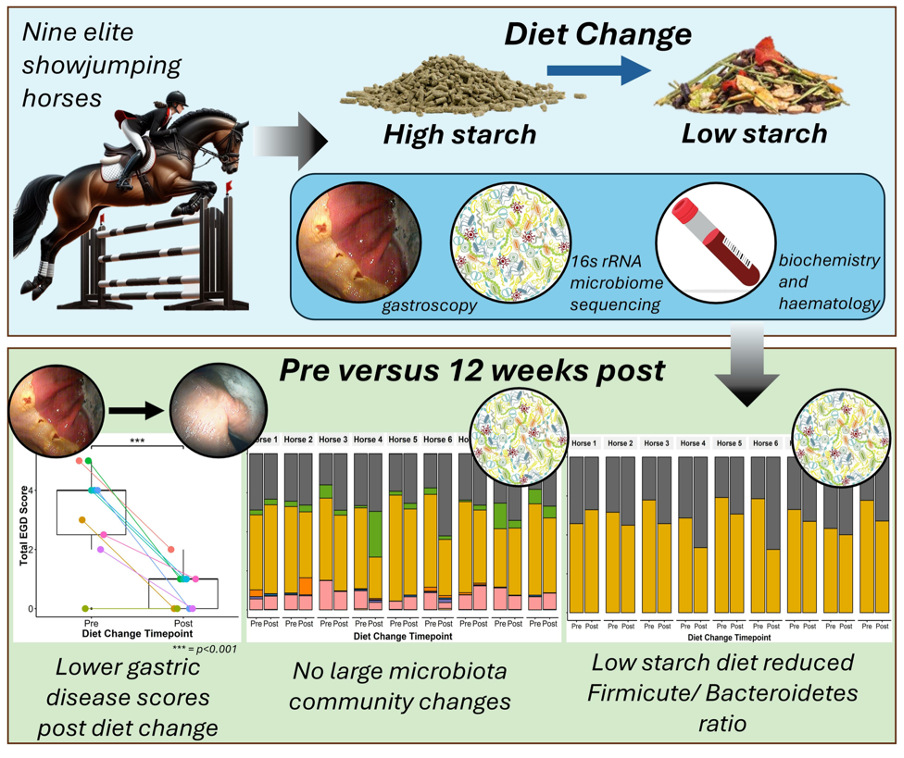
Figure 1. Impact of low-starch dietary modification on gastric disease scores and faecal microbiota in performance horses (Irving et al., 2025).
Low Starch: a number, not a marketing term
Many horse feeds are marketed as "low starch", but few horse owners know how much starch their horse is actually consuming.
Current recommendations suggest:
Less than 1 gram of starch per kilogram of body weight per meal
Less than 2 grams of starch per kilogram of body weight per day
For a 500 kg horse, that means:
No more than 500 g of starch per meal
No more than 1000 g of starch per day
Knowing the starch and sugar content of your horse's feed is therefore essential when managing ulcer-prone horses.
The power of forage
Forage remains one of the most important tools for protecting the stomach.
Continuous access to hay or pasture helps by:
Encouraging saliva production
Providing a physical fibre mat that helps prevent acid splashing onto the upper stomach
Supporting healthy digestive function
A study examining management changes in horses with severe ulcers found that free access to hay combined with low-starch feeding resulted in marked improvement, with some horses healing completely without medication (Kranenburg et al., 2023).
What about glandular ulcers?
Glandular ulcers appear to be influenced by more than diet alone.
Research suggests that stress plays an important role in EGGD development. Horses managed in high-pressure environments, exposed to frequent changes in routine or subjected to intensive exercise schedules may be at increased risk.
Factors associated with glandular disease include:
Single-box housing
Frequent changes in handlers or riders
Competition stress
Reduced turnout
Intensive training schedules
This highlights why ulcer management often requires a whole-horse approach rather than simply changing feed.
The gut microbiome connection
One of the newest and most exciting areas of research involves the horse's microbiome.
The microbiome refers to the billions of beneficial microorganisms living throughout the digestive tract.
Studies have found that horses with gastric disease may have reduced microbial diversity compared with healthy horses. Researchers are now investigating how feeding practices influence these microbial populations and whether improving gut microbial health may help reduce ulcer risk.
While much remains to be learned, the findings strengthen the case for forage-based diets and reducing excessive starch intake.
Practical steps to reduce ulcer risk
If your horse is prone to ulcers, consider the following strategies:
Provide continuous access to forage whenever possible.
Avoid large grain meals.
Check the starch and sugar content of concentrates.
Consider highly digestible fibre sources such as beet pulp.
Use oil and fibre to provide calories rather than relying heavily on starch.
Maintain consistent management routines.
Maximise turnout where practical.
Allow appropriate rest and recovery periods for competition horses.
Work with your veterinarian and equine nutritionist to develop an individual feeding program.
Reduce the number of days of work each week.
The take-home message
The latest research is changing our understanding of equine gastric ulcers. Rather than focusing solely on acid suppression, the evidence increasingly supports a comprehensive approach that includes forage-first nutrition, careful starch management, appropriate exercise, reduced stress and support for a healthy gut microbiome.
For many horses, what goes into the feed bin may be just as important as what comes out of the medicine cabinet. This is why understanding the starch and sugar content of a horse's diet is so important. A complementary low-starch, low-sugar balancer, such as all-4-feet®, can help provide essential vitamins, minerals, and biotin without adding unnecessary starch to the ration, allowing energy and protein sources to be adjusted according to the horse's individual needs. While no feed can prevent or cure gastric ulcers on its own, combining appropriate veterinary care with forage-based nutrition and careful starch management can play an important role in supporting long-term gastric health.
References
Böhm, S., Mitterer, T., & Iben, C. (2018). The impact of feeding a high-fibre and high-fat concentrated diet on the recovery of horses suffering from gastric ulcers. Pferdeheilkunde: Equine Medicine, 34(3), 237-246.
Irving, J., et al. (2025). Impact of low-starch dietary modifications on faecal microbiota composition and gastric disease scores in performance horses. Animals, 15(13), 1908.
Julliand, S., Buttet, M., Hermange, T., Hillon, P., & Julliand, V. (2023). Effect of diet composition on glandular gastric disease in horses. Journal of Veterinary Internal Medicine, 37(4), 1528-1536.
Kranenburg, L., et al. (2023). Changes in management lead to improvement and healing of equine squamous gastric disease. Animals, 13(9), 1498.
Sykes, B., & Lovett, A. (2025). Can all behavioral problems be blamed on equine gastric ulcer syndrome? Animals, 15(3), 306.
Vokes, J., et al. (2023). Equine gastric ulcer syndrome: An update on current knowledge. Animals, 13(7), 1261.
Dr Jennifer Stewart
BVSc BSc PhD Equine Veterinarian and Consultant Nutritionist

