
Equine Gastric Ulcers: Understanding the Impact of Domestication

Modern horses live in conditions vastly different from those of their wild ancestors. While contemporary management practices are designed to support performance, convenience, and safety, they may also help explain why gastric ulcers have become one of the most common health problems in horses today.
The contrast between domestic and feral horses is striking. Research reports gastric ulcers in 37% of pleasure horses and spelling Thoroughbreds, 40% of Western performance horses, 54% of show horses, 64% of sport horses, and up to 93% of racehorses in training. Ulcers have also been identified in 20–51% of foals and 41% of donkeys. Endurance horses provide a particularly revealing example: prevalence rises from approximately 16% outside the competition season to as high as 93% during competition. By comparison, only 2–7% of feral horses have been found to have gastric ulcers.
These figures raise an important question: to what extent are gastric ulcers a consequence of modern feeding and management practices? Are they a ‘disease of domestication’?
Two parts of the stomach, two different types of ulcers
The horse's stomach is unique. Unlike many other animals, only the lower half of the stomach is lined with specialised glands that produce protective mucus and digestive secretions that protect the stomach from exposure to acid. This region is known as the glandular stomach. The upper half, known as the squamous or non-glandular region, lacks this protective mucus layer and is therefore more vulnerable to injury from stomach acid (see Figure 1).

Figure 1. Structure of the equine stomach showing the protected glandular region and the more vulnerable squamous (non-glandular) region where most gastric ulcers occur.
Ulcers can develop in both regions of the stomach, but they occur for different reasons and are now recognised as two separate disease processes. As a result, the underlying causes, management strategies and treatment approaches can differ significantly depending on which part of the stomach is affected.
Most gastric ulcers occur in the unprotected squamous, non-glandular region. These ulcers develop when the delicate lining is exposed to gastric acid and acidic by-products produced during bacterial fermentation. Exercise is a major risk factor. At gaits faster than a walk, stomach contraction and increased abdominal pressure compress the stomach and force acidic stomach contents upwards into the squamous region. Exercise can also promote the reflux of bile and acidic fluids from the small intestine back into the stomach, further increasing the risk of ulceration. In endurance horses, the severity of squamous ulceration has been shown to increase with the duration of the ride.
Ulcers affecting the glandular region are generally less common, although they are still frequently reported in performance horses. They have been found in approximately 17-33% of endurance horses, 54-64% of leisure and sport horses, and 47-65% of Thoroughbred racehorses. Unlike squamous ulcers, glandular ulcers are not thought to result simply from acid exposure. Despite significant advances in research, the exact cause remains unclear, although stress, exercise duration and intensity, management practices and disruption of the stomach's normal protective mechanisms are believed to play important roles.
Equine Squamous Gastric Disease (ESGD), affecting the upper squamous region of the stomach
Equine Glandular Gastric Disease (EGGD), affecting the lower glandular region

The challenge of identifying gastric ulcers
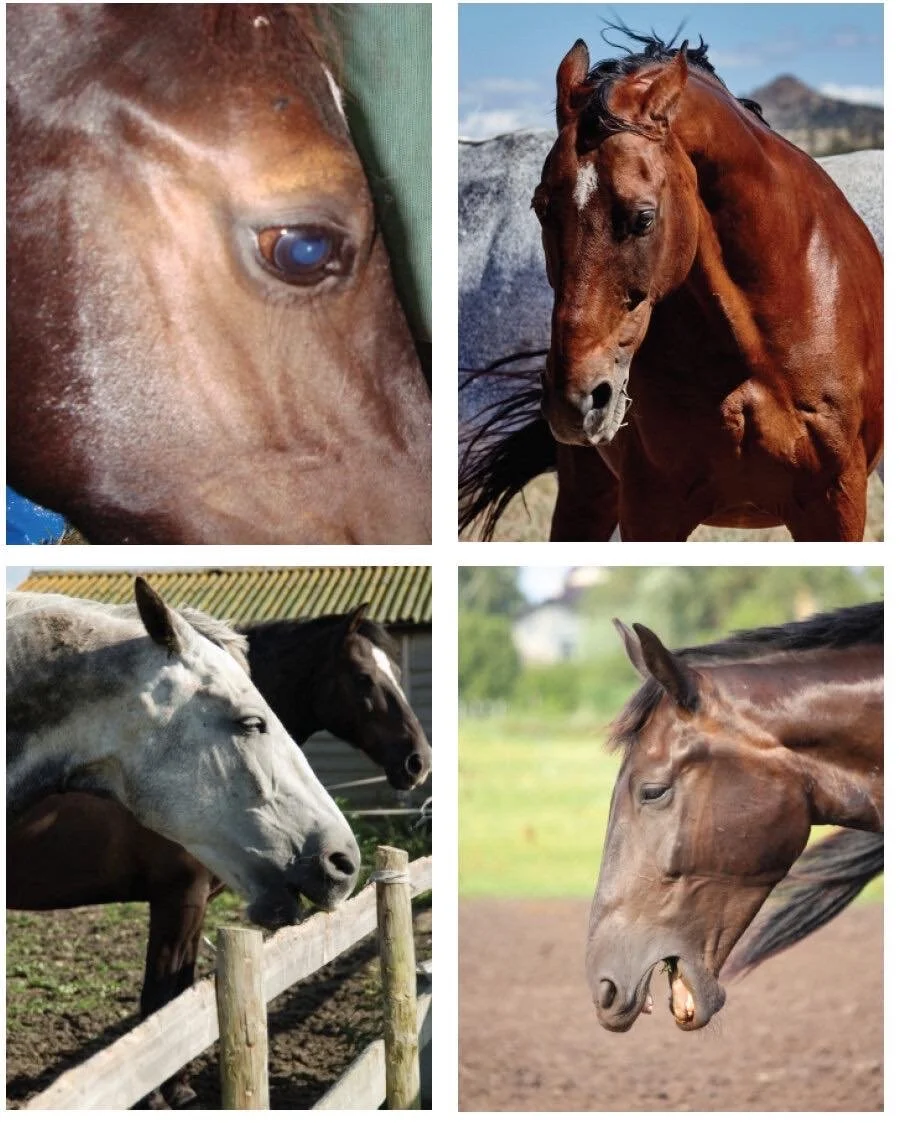
Stomach ulcers are often suspected when horses show changes in appetite, behaviour, health or performance. Common signs include a reduced appetite, particularly for grain feeds, picky eating, weight loss, poor body condition, recurrent mild colic (especially after eating), chronic diarrhoea, teeth grinding, belching and signs of abdominal discomfort. Some horses develop behavioural changes such as irritability, nervousness, aggression, crib-biting, wind-sucking or weaving. Others show reduced performance, decreased exercise tolerance, loss of vitality, bark or fence chewing, or spend more time lying on their back. Donkeys with gastric ulcers are often described as appearing "dull" or difficult to manage. However, in both horses and donkeys, these signs can occur with many other conditions.
Interestingly, equine squamous gastric ulcers share many similarities with gastro-oesophageal reflux disease (GERD) in people. Rather than resembling the classic bleeding ulcers often associated with human medicine, they are more comparable to acid reflux and heartburn. In people, GERD commonly causes chest discomfort, irritability, poor appetite and reduced quality of life. In horses, similar discomfort may present as girthiness, cold-backed behaviour, nappiness, a sour attitude, behavioural changes, reduced appetite, picky eating, weight loss and poor performance.
Performance effects are particularly relevant in athletic horses. In people, more than half of elite athletes report heartburn or gastro-oesophageal reflux that affects comfort and performance. Similarly, horses with gastric ulcers have been shown to have reduced oxygen uptake and shorter stride length, both of which can impair athletic performance.
Recent research has also improved our ability to recognise pain and discomfort through changes in body language and facial expression. Signs such as ears held stiffly backwards, tightening around the eyes, a strained mouth, tense nostrils, repeated yawning or "vacuum chewing" (chewing when no feed is present) may indicate discomfort and warrant further investigation.
However, none of these signs is specific to gastric ulcers, and all can occur with other health, pain or behavioural conditions.
The challenge of diagnosis
While the list of signs associated with gastric ulcers is long, diagnosing ulcers based on symptoms alone is surprisingly difficult. Studies in both the United States and the United Kingdom have found that 51% of foals and 84% of yearlings with gastric ulcers show no obvious clinical signs. At the other extreme, because gastric ulcers are so common, particularly in performance horses, almost any symptom could potentially occur in a horse that also happens to have ulcers.
The signs most strongly associated with gastric ulcers are a reduced appetite (especially for grain), discomfort after eating and teeth grinding. Even so, none of these signs is specific to ulcers, and each can be caused by a range of other health, pain, behavioural or lameness issues.
Why gastroscopy remains essential
For this reason, gastric ulcers should never be diagnosed on symptoms alone. Gastroscopy remains the only reliable way to confirm the presence of ulcers and to determine their severity and location.
Importantly, even when ulcers are identified during gastroscopy, they should not automatically be assumed to be the cause of a horse's symptoms. Other underlying problems must be ruled out, and the suspected ulcer-related signs should improve following appropriate treatment of concurrent conditions before ulcers can be confidently considered the primary cause.
Ulcers beyond the reach of the endoscope
A veterinary examination is important to rule out colonic (hindgut) ulcers, which can produce many of the same signs as stomach ulcers, including low-grade anaemia from chronic blood loss, irritability and poor nutrient absorption. While gastric ulcers are relatively easy to diagnose with gastroscopy, colonic ulcers can be much more difficult to detect and may be underdiagnosed.
A large UK post-mortem study of 545 horses, including leisure and performance horses, found that 97% had some form of ulceration and 60% had ulcers in the colon. These findings raise important questions about the causes of colonic ulcers, their impact on performance and their potential role in colic.
Management factors associated with ulcer risk
Studies investigating gastric ulcer prevalence have identified several management factors associated with an increased risk of ulceration. Many of these are closely linked to modern horse management and training and may help explain why ulcers are far more common in domesticated horses than in feral, free-living and wild populations.
Common risk factors include:
limited or no pasture turnout
feeding fewer than four meals per day
high-intensity exercise, particularly when performed too often during the week
prolonged stabling or confinement
diets high in concentrate ("hard") feeds
physical and psychological stress
moving horses from pasture to stables with restricted forage access
limited direct contact with other horses
solid stable walls that restrict visual and social interaction
lack of access to water in paddocks
straw feeding in some management systems
Research has shown that even relatively small changes in management, such as moving a horse from pasture to a stable, can increase the risk of ulcers. These findings highlight the importance of turnout, social interaction and free access to forage in supporting gastric health.
Managing ulcer risk during exercise
Exercise is a significant risk factor for both Equine Squamous Gastric Disease (ESGD) and Equine Glandular Gastric Disease (EGGD), although the mechanisms differ.
Exercise and ESGD
The prevalence of squamous (non-glandular) ulcers increases as exercise intensity increases, with ulcers capable of developing in as little as seven days in some horses.
Unlike humans, horses produce stomach acid continuously, regardless of whether they have eaten. During exercise, particularly at faster gaits, acidic stomach contents can splash onto the unprotected squamous lining in the upper stomach. This repeated acid exposure can lead to irritation and ulceration.
One of the simplest ways to reduce this risk is to ensure horses are never exercised on an empty stomach. Feeding a small amount of lucerne (alfalfa) hay 30 to 60 minutes before exercise helps buffer stomach acid and creates a protective fibre mat that limits acid splashing onto the squamous mucosa.
Nutrition and exercise management are the two most important factors in ESGD prevention. Key recommendations include:
provide adequate access to roughage.
limit high-starch feeds where possible.
feed a small amount of hay, particularly lucerne, before exercise. As little as 300 g may provide a significant buffering effect.
use multiple hay nets or other strategies that encourage forage intake.
schedule exercise when gastric buffering is likely to be greatest, typically in the afternoon when horses have consumed more forage.
limit cumulative exercise at a trot or faster to an average of less than 40 minutes per day where practical.
For horses receiving omeprazole, administering the medication before exercise and following it with a small feed may help maximise acid suppression during periods of greatest risk to the squamous mucosa.
Exercise and EGGD
While exercise intensity plays a major role in ESGD, exercise frequency appears to be more important for EGGD.
Research has identified the number of days worked per week as a key risk factor for glandular disease in Thoroughbred racehorses, Warmblood showjumpers and endurance horses. In endurance horses, the prevalence of EGGD has been shown to increase markedly during the competition season.
The exact cause is not fully understood, but one proposed mechanism is that exercise reduces blood flow to the stomach lining, limiting oxygen delivery to the glandular mucosa. Exercise may also act as a physiological stressor, making the glandular stomach more susceptible to disease.
Differences in EGGD prevalence among trainers further support the importance of management practices, particularly training frequency, over exercise intensity alone.
Current recommendations for horses prone to EGGD include:
provide at least two, and ideally three, full rest days each week.
avoid prolonged periods of continuous training without adequate recovery.
allow regular breaks from competition and intensive work.
provide a consistent, predictable and enriched environment.
encourage natural social behaviours, such as mutual grooming and social interaction, where possible.
Overall, the total workload and, in particular, the number of exercise days per week appear to be more important risk factors for EGGD than exercise intensity or duration.
Treatment: More than acid suppression
In human medicine, the phrase "No acid, no ulcer" reflects the central role of stomach acid in ulcer development. The same principle applies to Equine Squamous Gastric Disease (ESGD), where acid suppression with omeprazole remains the cornerstone of treatment.
However, glandular ulcers are often more difficult to treat. Only around 25% of glandular ulcers heal after 28-35 days of omeprazole therapy, compared with approximately 78% of squamous ulcers. In some horses, glandular lesions may even worsen during treatment, underscoring that glandular disease is often more complex than excess acid production alone.
Because omeprazole reduces stomach acidity, it may also impair the absorption of minerals such as calcium and magnesium. Horses receiving prolonged treatment may therefore benefit from a review of their dietary mineral intake and, where required, supplementation.
Practical management and nutritional support
Because horses are designed to graze for most of the day, minimising periods without forage is one of the most important strategies for maintaining gastric health. Even one hour with an empty stomach may cause discomfort in some horses, making continuous access to pasture or hay ideal wherever possible.
When grazing is limited, provide free-choice hay or divide forage into frequent meals throughout the day (ideally 4-6 feeds daily). Horses should consume at least 1.5 kg of forage per 100 kg bodyweight per day. For overweight horses and ponies, mature, lower-energy hay is preferable. If this is unavailable, higher-quality hay can be diluted with straw, although straw intake should be limited to 250 g per 100 kg bodyweight per day to reduce the risk of impaction. Hay is preferable to chaff as the short, sharp edges of chaff particles can cause mechanical damage to the stomach lining.
Sweet feeds and grains are best avoided, as they are fermented to acid by the resident stomach bacteria and contribute to acid production. Similarly, electrolyte pastes may increase the risk of squamous ulcers, so mixing electrolytes into feed is generally preferable.
A number of nutritional and management strategies may help support healing and reduce the risk of recurrence:
read feed labels and understand how much scratch is in your feed. Do not exceed 1g starch/kg body weight
feed concentrates in small meals (1-2 kg per feed), ideally with added lucerne.
maximise turnout and social contact with other horses.
minimise the stress associated with travel, competition and prolonged stabling.
feed 150-250 mL of corn oil daily for a 500 kg horse.
ensure adequate calcium and magnesium intake.
maintain an effective parasite control programme.
consider gastroprotective feedstuffs such as flaxseed, linseed, larch arabinogalactan, guar gum, pectin and psyllium.
consider supplements that support the stomach's natural protective mechanisms, including calcium- and magnesium-based antacids, pectin-lecithin complexes, and protectants such as kaolin, cellulose and gelatin. Other ingredients that may benefit some horses include chlorophyll, gamma-oryzanol (from rice bran), betaine, glutamic acid, and live yeast cultures such as Brewer’s Yeast (20-40g/day).
Nutritional ingredients that may help support the stomach's natural defence mechanisms include pectin-lecithin complexes, dried apple pectin, soy lecithin, lucerne (high in pectin), sodium bicarbonate, beta-glucans, polar lipids, natural antioxidants and live yeast cultures - Saccharomyces cerevisae, i.e., Brewer’s Yeast. These ingredients may help reinforce the stomach's protective mucus layer, bind bile acids and protect tissues against oxidative damage.
Sucralfate may be particularly useful for glandular ulcers, as it forms a protective barrier over damaged tissue and supports healing when used for extended periods. Calcium carbonate and other antacids may also help protect the vulnerable squamous lining from acid-related injury, and feeding oil increases gastric protective mucus production.
A word of caution about aluminium
Aluminium-containing antacids should be used with caution. While they can stimulate protective mucus production and support repair of the stomach lining, prolonged use has been associated with adverse effects in both people and horses. Where long-term supplementation is being considered, monitoring aluminium status via hair mineral analysis may be advisable.
Botanicals and the gastric microbiome
Specific guidelines for preventing glandular ulcers have not yet been established, but there is growing interest in botanicals such as sea buckthorn (Hippophae rhamnoides). Rich in vitamins, flavonoids, carotenoids and other bioactive compounds, sea buckthorn in horse-specific research-proven amounts may help support horses with glandular ulcer disease, although benefits for squamous ulcers have not been demonstrated.
There is also increasing evidence that the gastric microbiome plays a role in glandular ulceration. Horses with glandular ulcers appear to have fewer beneficial bacteria associated with the stomach lining, allowing opportunistic microorganisms to colonise damaged tissue. Early research suggests that combinations of fermented soy products and marine-derived algae may help re-establish a healthier gastric microbial population.
The take-home message
At Jenquine, we believe that prevention and the proactive protection of gut health is always better than a cure. While medications have an important role in treating gastric ulcers, long-term success depends on addressing the management and nutritional factors that contribute to their development in the first place.
Greater awareness of the importance of dietary fibre, regular forage intake, appropriate pasture access and careful starch management has significantly improved our ability to support equine digestive health. However, gastric ulcers are only one part of a much bigger gut health picture. Continued improvements in prevention, early detection, and management strategies are needed to reduce the impact of digestive disorders throughout the gastrointestinal tract.
Treatment decisions should always be made in consultation with your treating veterinarian. Horses with severe ulceration and clinical signs generally require treatment, while horses with ulceration detected on gastroscopy but showing no symptoms may not. Most ulcers heal within 21-28 days of appropriate therapy, although approximately 20% of horses require a different treatment approach or management changes, such as increased pasture turnout and feeding less than 1g starch/kg body weight per meal and less than 2g starch/kg body weight per day (read the feed labels).
While medications can provide rapid relief, nutritional and management changes take longer to show results. The digestive system needs time to adapt, repair and restore normal function. In the long term, addressing the underlying causes of gastric disease to protect stomach health rather than simply suppressing symptoms is often the key to lasting success.
Our understanding of gastric ulcer disease continues to evolve. To learn more about the latest research on starch intake, the gastric microbiome, stress and ulcer prevention, read our companion article, Equine Gastric Ulcers: What New Research Means for Your Horse.
Dr Jennifer Stewart
BVSc BSc PhD Equine Veterinarian and Consultant Nutritionist

